Good afternoon!
For the latest updates from ICT in the insurance industry, follow us on LinkedIn and make sure to enable notifications 🔔
For more Texas-related P&C insurance information and news, visit the ICT website
|
Due to the Thanksgiving holiday, we will not be publishing a newsletter next week. We’ll return with our next edition the week of November 30.
We hope you enjoy a warm, restful, and joyful holiday season with your loved ones.
Thank you for being a valued reader, and we look forward to reconnecting with you the following week.
Happy Holidays from ICT!
|
Texas Legislative Update: Leadership Transitions and Early Bill Filing
|
With the 90th Texas Legislature set to convene Jan. 12, 2027, preparations are underway following the Nov. 3 elections. Gov.-elect Gina Hinojosa and Lt. Gov.-elect Vikki Goodwin have announced bipartisan transition teams, providing an early look at the individuals who will help guide the transition to new state leadership.
Attorney General-elect Nathan Johnson has also announced his transition team, with Texas Insurance Commissioner Amanda Crawford serving as transition director. The team also includes Lani Lappinga, Sen. Royce West, U.S. Rep. Joaquin Castro, Erin Epley, Mark Penley and other legal, governmental and business leaders. Crawford’s role is especially notable for the insurance industry as Texas prepares for potential leadership changes at the Texas Department of Insurance.
While many questions remain, appointments to key insurance regulatory positions, including the insurance commissioner and workers’ compensation commissioner, will be important developments to watch.
In the House, Rep. Senfronia Thompson, D-Houston, appears to have solidified her position as the front-runner to become the next speaker. Thompson has announced support from a majority of House members, including several Republicans, and has begun preparing for the upcoming session. Notably, current House Insurance Committee Chair Jay Dean, R-Longview, and House Calendars Committee Chair Todd Hunter, R-Corpus Christi, are among her Republican supporters. Thompson has indicated that she intends to appoint committee chairs from both parties, although changes to committee leadership and membership, including the House Insurance Committee, are still expected.
Meanwhile, bill prefiling began Nov. 9, with 1,262 bills and resolutions filed on the first day, the second-highest opening-day total on record. Several bills of interest to the property and casualty insurance industry have already been filed, including proposals to require prior approval for certain residential property and personal auto rate changes (HB 226), prohibit oral releases for auto insurance claims (HB 431), establish annual premium limits for auto liability insurance (HB 522), license and regulate roofing contractors (SB 62) and restrict the use of credit scoring in certain personal insurance lines (SB 309).
ICT has begun tracking legislation and will continue sharing updates on bills of interest to the property and casualty insurance industry as filing activity increases and the legislative session approaches.
|
|
TWIA Board Approves 2027 Budget, Tables Agent Commission Discussion
|
The Texas Windstorm Insurance Association (TWIA) Board of Directors met Nov. 10 in Corpus Christi and virtually for its quarterly meeting. The board approved its 2027 operating budget, authorized short-term financing for additional 2024 storm losses and revisited the issue of agent commissions. Meeting materials are available here.
Below are key takeaways from the meeting:
- Agent commissions: The board received additional information on agent commissions following its August meeting, including a report on higher errors and omissions insurance costs for coastal agents and a comparison of the statutory requirements for issuing TWIA policies versus policies in the voluntary market. The Independent Insurance Agents of Texas opposed potential commission reductions. Following discussion, the board voted to table the issue without establishing a timeframe for reconsideration.
- 2027 TWIA budget approved: The board approved the proposed 2027 budget. Key highlights include:
- TWIA’s policy count and written premiums are projected to continue leveling off and declining in 2027.
- The Catastrophe Reserve Trust Fund is projected to end 2026 with about $59 million. Assuming no significant storm losses, the balance could grow to about $350.5 million by the end of 2027.
- TWIA’s 1-in-50 probable maximum loss is projected to increase from about $4.3 billion in 2026 to $4.4 billion in 2027. Despite the higher exposure, reinsurance costs are expected to continue declining. TWIA projects spending about $173 million on reinsurance in 2027, compared with about $210 million in 2026 and $432 million in 2025.
- Short-term financing for Hurricane Beryl losses: The board approved a resolution authorizing TWIA to pursue about $44 million in short-term financing to cover additional losses from Hurricane Beryl and other 2024 storms. TWIA has exhausted available funding from its 2024 Catastrophe Reserve Trust Fund. Staff expects to repay the financing within a few days using available cash, with the amount ultimately funded through TWIA’s 2026 net gain from operations.
- Legislative update: General Manager David Durden provided a legislative update ahead of the 90th Texas Legislature. He noted that rulemaking to implement HB 3689 was still being developed. TWIA is also preparing its Biennial Report to the Legislature, which will include legislative recommendations approved by the board in October, including proposals addressing multidistrict litigation, mitigation, catastrophe funding and depopulation.
- Catastrophe modeler and 2027 probable maximum loss determination: The board approved Howden Re as TWIA’s new catastrophe modeler, replacing Aon, following a request for proposals process. TWIA is required to use a catastrophe modeler separate from its reinsurance broker, which is currently Gallagher Re.
The TWIA board will need to hold a special meeting in December or January to review the catastrophe modeling methodology used to determine TWIA’s 2027 1-in-50 probable maximum loss. Following the special meeting, the board will hold its next quarterly meeting Feb. 23 in Galveston.
ICT members can view a full recap on the ICT member Info Hub.
|
|
Texas FAIR Plan Governing Committee Meets for Quarterly Meeting
|
The Texas FAIR Plan Association Governing Committee met Nov. 9 in Corpus Christi and virtually for its quarterly meeting. The committee approved its 2027 budget and voted to move forward with its annual rate filing.
Below are key takeaways from the meeting:
- Rate filing: The committee approved moving forward with a rate filing that caps increases and decreases at 15% by territory, compared with the 25% cap used for its 2026 filing. The actuarial review indicated a modest 1.4% statewide increase for homeowners coverage, while other policy forms generally indicated decreases. The filing will be submitted to TDI for review and approval.
- Policy counts: TFPA continues to see declining policy counts as more business returns to the private market. New policy issuance is down 45% year over year, with Tier 2 policies declining 21%. However, Tier 1 coastal policies continue to grow, increasing 11%.
- 2027 budget: The committee approved a budget projecting a 22.4% decline in policies, a 23.7% decrease in written premiums and lower reinsurance costs. TFPA’s surplus is projected to grow from about $150 million at the end of 2026 to $226.6 million by the end of 2027, assuming budgeted results.
The committee’s next quarterly meeting is scheduled for Feb. 22, 2027, in Galveston. Meeting materials are available here.
ICT members can view a full recap on the ICT member Info Hub.
|
TDI Adopts SB 458 Appraisal Rules; Extends Compliance Date to March 1, 2027
|
TDI proposed new 28 TAC Sections 5.6701 and 5.6702 on Nov. 10 to implement the workers’ compensation reporting requirements under HB 2067, passed by the 89th Legislature. The rules propose adopting by reference a new Texas Declination Statistical Plan for Workers’ Compensation to inform insurers how to submit declination data required under Insurance Code Section 551.006. As a reminder, HB 2067 requires insurers to provide consumers with reasons for the cancellation, nonrenewal or declination of coverage and report that information to TDI. The department has already adopted reporting requirements for residential property and personal auto insurance and separately proposed requirements for commercial lines.
TDI proposes using the National Council on Compensation Insurance, its workers’ compensation statistical agent, to collect the required information. The proposal establishes new reporting requirements for declinations but relies on existing reporting for cancellations and nonrenewals to avoid duplicative reporting.
Key provisions of the proposal include:
-
Declination reporting: Insurers would submit quarterly reports to NCCI identifying the primary reasons for declining completed and submitted applications. The statistical plan establishes eight reason codes, including classification or hazard, operations, claims history, safety programs and misrepresentation or fraud. Insurers with no declinations would still be required to submit a report.
-
Cancellation and nonrenewal reporting: TDI would use information already collected under existing workers’ compensation reporting requirements rather than requiring insurers to submit separate reports.
-
Implementation: The new declination reporting requirements would apply beginning July 1, 2027, with the first quarterly report due Oct. 31, 2027.
TDI will hold a public hearing at 10 a.m. Dec. 11, and written comments are due Jan. 6, 2027.
ICT is working with its committees to gather member feedback on the proposal.
|
ICT Education Foundation Celebrates 45 Scholarship Recipients
|
The ICT Education Foundation congratulates the 45 students selected to receive scholarships in 2026. Representing six Texas universities, these recipients have demonstrated academic achievement, leadership and an interest in building careers in the property and casualty insurance industry.
For ICT members, supporting scholarships is an investment in the industry’s future. By helping students pursue their education, the Foundation encourages emerging talent to explore insurance careers and develop the knowledge and skills our member companies need. These students could become tomorrow’s underwriters, claims professionals, risk managers, agents and industry leaders.
Thank you to the companies and individuals whose generosity makes this program possible. If you or your company have not yet contributed this year, please consider a donation to the ICT Education Foundation. Your support helps open doors for students and strengthens the connection between Texas insurance education and career opportunities.
Please join us in congratulating this year’s recipients, listed alphabetically by last name:
- Sara Acevedo — University of Houston-Downtown
- Maryam Ahmad — The University of Texas at Dallas
- Aaron Anton — St. Mary’s University
- Nicolas Arambulo — St. Mary’s University
- Soha Arian — The University of Texas at Dallas
- Valentina Asfura — St. Mary’s University
- Matthew Bidwell — The University of Texas at Dallas
- Joshua Bonnett — The University of Texas at San Antonio
- Gloria Bou Onk — St. Mary’s University
- Avis Bright — University of North Texas
- Jennifer Calandra — University of Houston-Downtown
- Vlad Chiorescu — St. Mary’s University
- Roneld Clay — University of Houston-Downtown
- Fabricio Condemarin Saenz — St. Mary’s University
- Rodrigo Elizondo — St. Mary’s University
- Johan Espinosa — University of Houston-Downtown
- Leonardo Fabbri — St. Mary’s University
- Alberto Garza — St. Mary’s University
- Courtney Gonzales — University of Houston-Downtown
- Marium Irfan — The University of Texas at Dallas
- Matthew Janecek — St. Mary’s University
- Blake Kump — University of North Texas
- Jenna Lee — St. Mary’s University
- Chanel Lowery — St. Mary’s University
- Abdullah Mohammad Mahi — St. Mary’s University
- Arturo Martinez Polanco — St. Mary’s University
- Max Masabo — St. Mary’s University
- Aaryan Mongia — The University of Texas at Dallas
- Angie Nois — University of North Texas
- Dilly Ogunrinde — St. Mary’s University
- Parker Oldham — University of North Texas
- Javier Perez Luna — The University of Texas at Dallas
- Kade Ramer — University of North Texas
- Rashmi Ravindran — The University of Texas at Dallas
- Roland Rojas — St. Mary’s University
- Emma Sanchez — St. Mary’s University
- Na’Torian Solomon — University of North Texas
- David Sutjianto — The University of Texas at San Antonio
- Ilaria Tosato — University of Houston-Downtown
- Jennifer Tran — The University of Texas at Dallas
- Ariana Ventura — University of Houston
- Montserrat Virgilio Bernal — St. Mary’s University
- Sri Supraja Vishnubhatla — The University of Texas at Dallas
- Muhammad Hammad Zafar — St. Mary’s University
- Annie Zhao — The University of Texas at Dallas
|
|
Home insurance premiums climb at nearly four times global pace
|
U.S. homeowners insurance premiums increased nearly four times faster than the median rate across 27 Organisation for Economic Co-operation and Development (OECD) countries in 2025, according to the OECD's Global Insurance Market Trends 2026 report. U.S. premiums rose 8.2% year over year, compared with a 2.1% median increase internationally, reflecting continued pressure from previous claims costs, inflation and reduced competition in high-risk markets. Although the U.S. homeowners insurance industry returned to underwriting profitability in 2025 and rate increases are moderating, many homeowners continue facing elevated premiums and affordability challenges.
Key points
- U.S. homeowners premiums are rising faster than most international markets: U.S. premiums increased 8.2% in 2025, nearly four times the OECD median of 2.1%. Only Turkey, France and Norway recorded larger increases among the 27 countries analyzed.
- International insurance markets are experiencing different trends: While 22 of the 27 countries recorded premium increases, the United Kingdom experienced a 15.9% decline. Differences in competition, regulatory environments and claims costs contributed to varying premium trends.
- Homeowners insurers returned to underwriting profitability: The U.S. homeowners insurance segment recorded a $16.5 billion underwriting gain in 2025, its first annual underwriting profit since 2019, reversing a $1.3 billion loss in 2024.
- Rate increases are continuing to moderate: According to AM Best, average approved homeowners insurance rate increases slowed from 13.5% in 2024 to 7.6% in 2025 and 4.3% during the first half of 2026, reflecting improved underwriting results and stabilizing reinsurance conditions.
- Affordability remains a challenge despite improved market conditions: Homeowners insurance premiums increased 24% between 2021 and 2024, according to the Consumer Federation of America, adding approximately $21 billion in costs for U.S. homeowners. Reduced insurer competition in high-risk markets and rising rebuilding costs continue to affect coverage availability and affordability.
|
Texas moves to track every workers’ comp rejection through NCCI
|
The Texas Department of Insurance (TDI) has proposed new workers’ compensation reporting requirements to increase transparency around why insurers decline coverage applications. Under the proposal, insurers would begin tracking and reporting declination data quarterly through the National Council on Compensation Insurance (NCCI) starting July 1, 2027, with aggregated results made publicly available. The changes implement provisions of House Bill 2067, passed in 2025, and are intended to improve regulatory oversight while eliminating outdated and duplicative claims reporting requirements.
Key points
- TDI proposes new quarterly declination reporting: Insurers writing workers’ compensation coverage in Texas would be required to report the number of declined applications and their reasons to NCCI each quarter, including when no applications were declined.
- HB 2067 expands insurance market transparency: The 2025 law requires insurers to explain coverage declinations, cancellations and nonrenewals to policyholders. The proposed rules would establish additional reporting requirements that allow TDI to monitor coverage decisions and publish aggregated data.
- Existing cancellation and nonrenewal reporting will remain in place: TDI determined that workers’ compensation insurers already report cancellation and nonrenewal information under existing regulations, eliminating the need for additional reporting requirements in those areas.
- Outdated claims reporting requirements would be eliminated: TDI proposes repealing the Texas Detailed Claim Information Statistical Plan because similar information is already reported through existing workers’ compensation data systems. Eliminating duplicate reporting is expected to reduce administrative and compliance costs.
- Insurers have until January to submit comments: TDI will hold a public hearing Dec. 11, 2026, and accept written comments through Jan. 6, 2027. The proposed declination reporting requirements would apply to coverage applications declined beginning July 1, 2027.
|
With Dwindling Litigation, GEICO Says it Doesn’t Need 114 Legal Staffers in Florida
|
GEICO plans to eliminate 114 remote legal staff positions in Florida as declining claims litigation following the state's 2022 and 2023 insurance reforms reduces the company's need for legal support. The reforms, which eliminated one-way attorney fees and assignment-of-benefits agreements, have been credited with reducing excessive claims litigation, improving market stability and contributing to lower insurance rates. The developments highlight how changes to Florida's legal environment are affecting insurers' operations, with several carriers announcing rate reductions and more than 20 new insurers entering the state's market.
Key points
- GEICO plans to eliminate 114 legal staff positions: The insurer announced plans to lay off 114 remote employees reporting to its Lakeland, Florida, office, with separations beginning around Dec. 31, 2026, and continuing through April 30, 2027.
- Declining litigation is driving operational changes: Although GEICO's official layoff notice did not specify a reason, a company spokesperson confirmed that reduced litigation following Florida's insurance reforms prompted adjustments to its staff counsel operations.
- Florida's tort reforms are reshaping the insurance market: Legislative changes enacted in 2022 and 2023 eliminated one-way attorney fees and assignment-of-benefits agreements, measures credited with discouraging excessive claims litigation and creating a more predictable claims environment.
- Insurers are announcing rate reductions: GEICO announced auto insurance rate reductions affecting approximately 2 million Florida policyholders in March. AAA also announced a 10% average auto rate reduction for its Florida Select Auto and Select Package Auto products in November, citing improving market conditions and legal reforms.
- Florida's insurance market is showing signs of stabilization: Multiple property insurers have reported rate reductions over the past two years, while more than 20 new carriers have entered the Florida market, reflecting improved operating conditions and increased insurer participation
|
Billion-Dollar U.S. Wildfires: New Data Reveals Rising Costs and Frequency
|
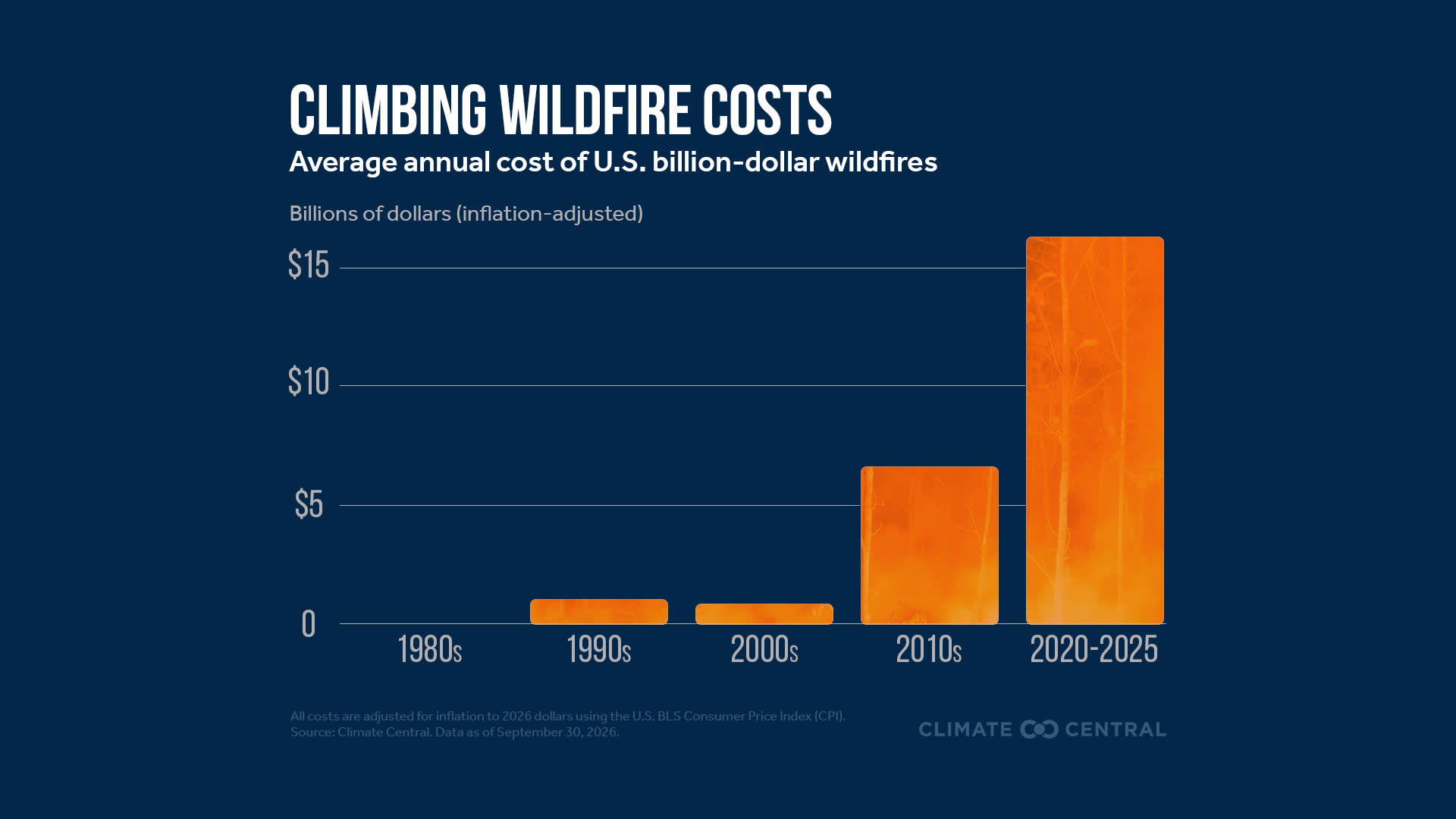
A new Climate Central analysis found that billion-dollar wildfires in the United States have become more than five times as frequent and 10 times as costly over the past 20 years compared with the previous two decades. Since 1980, 31 individual wildfires have caused nearly $186 billion in damages, destroyed more than 79,500 structures and resulted in an estimated 373 deaths. The findings highlight the growing financial and human costs of wildfires, driven by increasingly dangerous fire conditions and expanding development in wildfire-prone areas, with implications for property insurance, infrastructure and community resilience.
Key points
- Billion-dollar wildfires are becoming more frequent and costly: The number of billion-dollar wildfires increased from five during 1987-2006 to 26 during 2007-2026, while inflation-adjusted damages rose from $15.6 billion to $170 billion.
- California accounts for the majority of catastrophic wildfire losses: California experienced 23 of the nation's 31 billion-dollar wildfires since 1980, representing 74% of the total and approximately $167 billion in damages. Texas is also among the states that have experienced individual billion-dollar wildfires.
- Wildfires are among the nation's costliest natural disasters: Between 2016 and 2025, billion-dollar wildfires ranked third in both frequency and total damages among major weather and climate disasters, behind severe storms and tropical cyclones.
- Updated wildfire data reveals a larger national disaster toll: By tracking individual wildfires rather than grouping them into annual events, Climate Central revised the total number of U.S. billion-dollar disasters since 1980 from 447 to 453, representing $3.2 trillion in damages and approximately 17,200 deaths.
- Growing wildfire exposure highlights the importance of resilience: Climate Central identifies changing weather conditions and increased development in fire-prone areas as contributors to escalating losses. The findings reinforce the importance of wildfire mitigation, resilient construction and risk-informed development to help reduce future property damage and economic losses.
|
Check out all things ICT!
|
Enjoying this newsletter? Feel free to share it with your colleagues! Just a reminder: The ICT News to Know is a benefit exclusive to ICT members and we ask you not share outside your organization.
|
|